

AI sex toys are one of the fastest-moving corners of sex tech and one of the most loosely defined. Product pages promise companions that talk back, devices that learn your preferences, and experiences shaped by artificial intelligence. Some of that is real, some of it is a rebrand of older features, and almost all of it raises questions about the intimate data behind it.
This guide separates what these devices actually do today from what is still marketing, with a close look at personalization and privacy.
Key Takeaways
- “AI” on a sex toy can mean anything from a voice-controlled preset to a two-way companion, so check what the AI actually does.
- Most personalization today comes from custom modes and saved patterns, not deep learning of your body or habits.
- Data about a person’s sex life is treated as especially sensitive under UK GDPR, so an app or account deserves a careful look.
- A device that works fully on its own controls gives you a privacy fallback if you do not want to connect anything.
- Read the privacy notice for the app and any AI service, not only the store’s policy.
What Counts as an AI Sex Toy?
AI, Smart, and App-Connected
These three labels get used interchangeably, but they describe different things. An app-connected toy is remote-controlled from a phone. A smart toy adds features such as sensors, saved patterns, or video sync. An AI toy adds a layer that interprets input, such as spoken commands or conversation, and responds to it rather than following a fixed script.
[Suggested infographic placement: a three-tier ladder from manual to app-connected to AI-responsive, placed directly above the table below]
| Type | What it does | Typical requirements |
| App-connected | Phone controls speed, mode, and patterns | Bluetooth or internet, companion app |
| Smart | Adds sensors, saved patterns, or video sync | App, sometimes an account |
| AI-responsive | Reacts to voice or conversation in real time | App, often an account and an online service |
Where Hardware Ends and AI Begins
The physical device is still a motor, a sleeve, and a battery. AI does not change the mechanics. What it changes is how the device is directed. A voice request like “slower” or a companion that reacts to a conversation replaces a slider or a button press. The quality of the experience therefore depends on both halves: how well the hardware can carry out the change, and how reliably the software interprets what you asked for.
Core Features Explained
Multi-Motor Motion
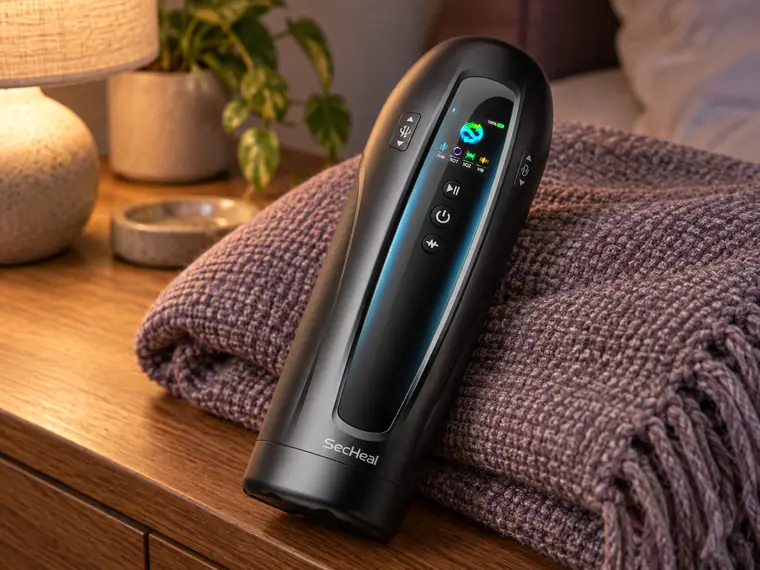
Better hardware gives an AI layer more to work with. A single-motor toy can only change speed. A device with independent motors can vary several motions at once, which makes responsive control more meaningful. Secheal Pulse is an AI-enabled automatic male masturbator built around two independent motors that coordinate 360° rotation, adaptive air pressure, and dual vibration alongside its stroking motion. Each motion can run alone or be layered with the others.
Voice Commands and AI Companions
The most visible AI feature is the companion. Instead of tapping a screen, you talk to it, and it adjusts the device or keeps the conversation going. Pulse pairs a real-time AI companion that talks back with hardware that can change several motions at once. The practical question for any product is how much of that interaction depends on an online service.
Video Sync vs Two-Way Response
Video sync reads cues from compatible content and moves the device to match. It is one-way: the device follows what is playing. A two-way system reacts to you and adjusts its behavior in return. Both get marketed as “interactive,” which is why the distinction matters when comparing products. For a deeper look at motion types and controls, see motion and smart features guide.
Remote Play for Couples
Remote control lets a partner adjust a device from another location through an app. It usually needs a stable connection on both ends and an account with the manufacturer’s app. That makes it convenient for long-distance couples, and it is also a good reason to read the privacy notice for that service before using it. For a closer look at remote play, see this guide to long-distance partner play.

Personalization Today
Presets and Custom Modes
Most real personalization is unglamorous. It means preset patterns, custom modes, and quick controls that work with no AI involved at all. Pulse, for example, offers Manual, three Auto modes, Custom, and Finisher. Finisher is a one-second hold on the plus or minus control that jumps to maximum or minimum speed, and it is manual rather than automatic.
What “Learning” Really Means
When a product says it “learns,” check what it is learning from. Some systems simply adapt within a session, adjusting to the instructions you give. Learning that carries across sessions requires storing your usage history somewhere, and the more a toy remembers about you, the more sensitive data exists about you. Personalization that stays inside a session or on the device carries little risk. Personalization built on stored profiles deserves the same scrutiny you would give any service holding intimate information.
Privacy and Data Risks
Why Intimate Data Is Different
Information about a person’s sex life is not ordinary personal data. Under UK GDPR, data concerning sex life counts as special category data, and organizations processing it need an additional legal condition on top of the usual lawful basis, according to the ICO’s special category data guidance. The same guidance covers data that reveals or concerns these details, not only data that states them outright, and it flags profiling as an activity that can bring data into scope. For readers in the UK and Europe, this is why usage logs, chat history, and preference profiles from an intimate device deserve extra care.
Regulators Are Paying Attention
Scrutiny of AI companions is rising. In September 2025, the US Federal Trade Commission ordered seven companies operating consumer AI companion chatbots to explain how they test safety, protect children and teens, and use or share personal information gathered through conversations, as described in the FTC announcement. That inquiry targets chatbots rather than sex toys, but the questions it raises about conversation data apply equally to any device with an AI companion layer.
Questions to Ask Before Buying
[Suggested infographic placement: a one-page privacy checklist graphic covering account, cloud, retention, and deletion, placed directly above the table below]
| Question | Why it matters | Where to check |
| Is an account required? | Accounts link usage to your identity | Product page, app store listing |
| Is data processed on the device or online? | Online processing means data leaves your phone | Privacy notice for the app or AI service |
| How long is data kept? | Long retention increases exposure | Privacy notice |
| Can data be deleted? | Deletion rights vary by region | Privacy notice, contact page |
One caution: a store’s privacy policy and an app’s privacy notice are often different documents. A store policy may only cover orders and website visits, and may say that a separate notice will apply to any app or AI service. Read the one that covers the feature you plan to use.
Why Offline Use Matters
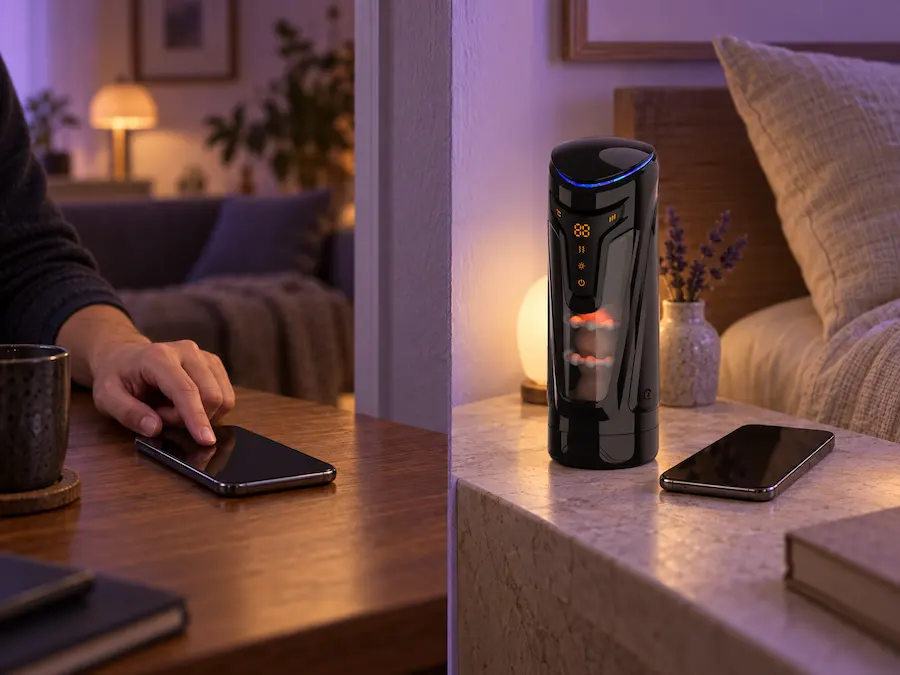
The simplest privacy protection is a device that does not need to connect at all. Pulse works that way: every on-toy mode runs offline, and connected features are optional. Secheal Ember works in a similar way, with heat and vibration controls on the body so a full session starts without an app. Even if you want AI features, a solid offline mode means you decide when, and whether, to connect.

What Is Real Today
Already Available
These capabilities exist in shipping products and can be evaluated today:
- Multi-motor hardware that layers stroke, rotation, air pressure, and vibration
- Preset and custom modes
- Voice and conversational control on some devices
- Remote partner control through an app
- On-device controls that work without an app
Still Mostly Marketing
[Suggested infographic placement: a “claim versus reality” graphic, placed directly above the table below]
| Common claim | Reality check |
| “Learns your body” | Usually adapts within a session or from saved settings, not from any physical understanding |
| “Fully private” | Depends on what data the app and any online service actually handle |
| “Truly intelligent” | Often means voice commands mapped to preset actions |
| “Replaces a partner” | A device and a companion do not replace human connection |
How to Choose
Match Features to Real Needs
Start with what you actually want. If you mainly want strong, layered motion, prioritize the hardware. If you want a conversational experience, look closely at how the AI works and where it runs. If you want to use the device with a partner far away, confirm what remote play requires on both ends.
Red Flags to Avoid
- Vague claims about “AI” with no description of what it does
- No privacy notice for the app or AI service
- Mandatory accounts for basic features
- No way to use the device without connecting it
- No clear way to delete your data
FAQ
What makes a sex toy an AI sex toy?
An AI sex toy adds software that interprets input, such as spoken commands or conversation, and responds to it in real time. A toy that only follows a fixed pattern or a phone slider is app-connected or smart, but not AI-responsive.
Do AI sex toys need an internet connection?
Not always. Some devices work fully on their own controls, and some tie AI features to an online service. Pulse’s on-toy modes, for example, work offline, and connected features are optional.
Can an AI sex toy learn my preferences?
Some can adapt during a session or save your settings. Long-term learning requires storing usage history, so ask where that history lives and whether you can delete it.
Do AI sex toys collect personal data?
It depends on the product. Accounts, usage logs, and conversations can all count as personal data, so read the privacy notice that covers the app or AI service you plan to use.
Can I use an AI sex toy without an app?
On many devices, yes. Look for on-toy controls and a clear statement that a full session works without an app.
Can a partner control an AI sex toy remotely?
Many app-connected devices support remote control. It usually requires an app and stable connections on both ends, so check the privacy notice for the service involved.

Hi, this is a comment.
To get started with moderating, editing, and deleting comments, please visit the Comments screen in the dashboard.
Commenter avatars come from Gravatar.